Choosing a licensed inspector in NSW
How to choose a pre-purchase inspector in Newcastle and the Hunter without a preferred-partner list — licences, insurance, sample reports, and the questions that still matter.
By Mark Ellison, Standards editor · 30 January 2024 · Updated 4 February 2026 · 11 min read
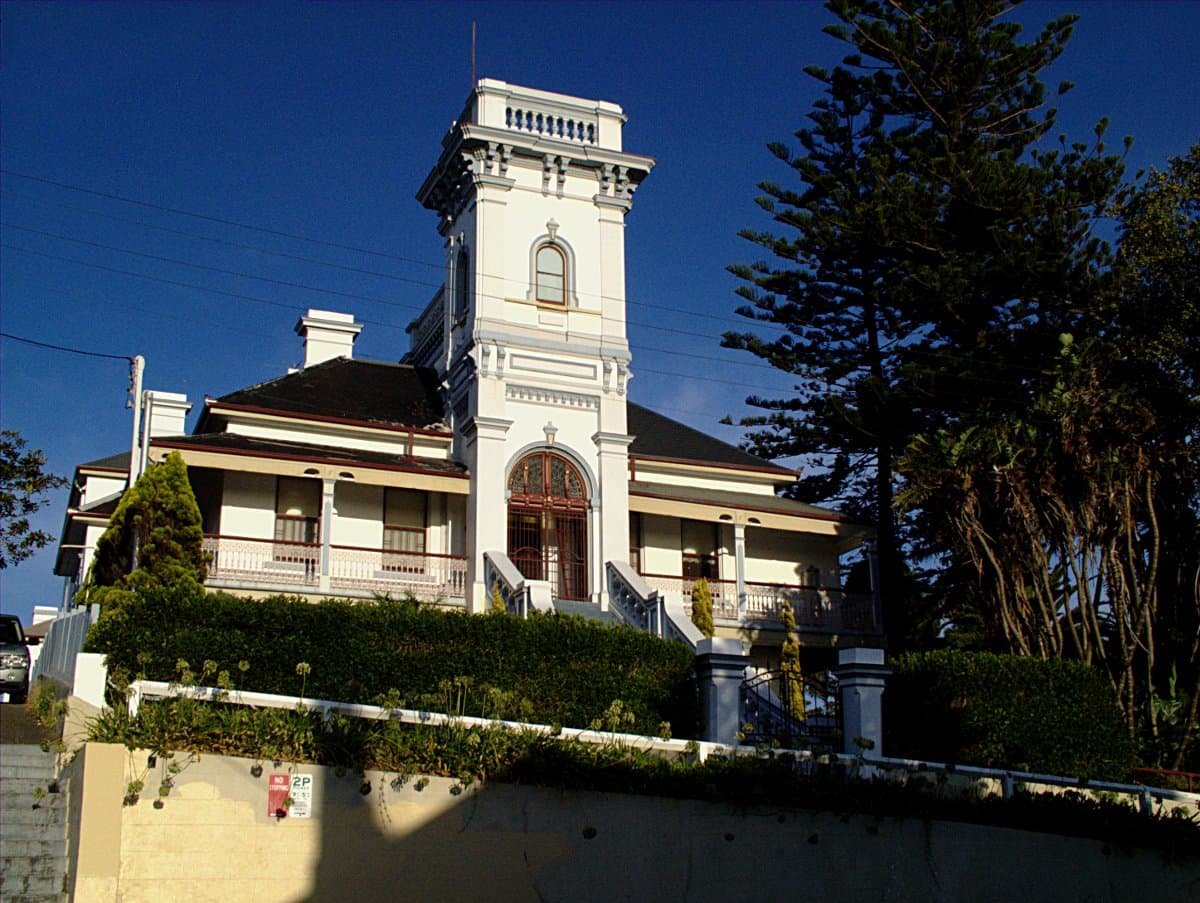
Photo: Mark McIntosh. Jesmond House. CC BY-SA 3.0. Source on Wikimedia Commons. Licence. Full credits on the image credits page.

The cheapest name in a Facebook group is not a method. In New South Wales a pre-purchase report is only as good as the person who wrote it, and the person who wrote it is only as good as their licence, their insurance, and the hour they actually spent in the roof. Newcastle and the Hunter make that hour harder than a brochure suggests. The stock is mixed, the weather is wet, and the market still likes to treat the inspection as a box to tick on the way to exchange.
This essay is about how to choose the inspector, not how to read the PDF they send you. The reports and standards hub is the wider file. If you want the walk-through itself, start with what a pre-purchase building inspection covers. We do not recommend a firm. We do not keep a preferred list. The point is to make you a harder person to hurry.
The licence, in general terms
NSW Fair Trading keeps a public register of contractor licences. That register is the first check, not the last. Before you pay a deposit on a report, search the name of the person or the company and read what the licence actually authorises.
A few distinctions matter more than the logo on the van.
A licence to do building work is not automatically a licence to inspect. Plenty of competent builders can tell you what they would fix. That is not the same job as writing an AS 4349.1 report for a buyer who is about to borrow against the house. Some inspectors hold a contractor licence in a building class and have added inspection work to a long trade. Some work as consultants under a different arrangement. The register will tell you what is on the paper. It will not tell you whether the person still crawls under floors.
The company and the person are not always the same entry. A trading name can sit over several inspectors. Ask who will attend. A senior name on the invoice and a junior with a clipboard on the day is a common pattern, and it is not automatically a problem — if you knew that when you booked.
Restrictions and history are worth a minute. The public record can show conditions, suspensions, or a trail of complaints. It can also show nothing of interest. Absence of a mark is not a character reference. Presence of a mark is a reason to ask, not a reason to invent a story.
Fair Trading is a regulator, not a referral service. The register answers a narrow question: is this person allowed to do the work they are offering? The rest of the choice is yours. That is why the pre-purchase hub spends so much time on what the inspection is for.
Building versus pest
In this city the usual package is “building and pest”. It is convenient. It is also two standards sharing an afternoon. A building inspection written to AS 4349.1 and a timber pest inspection written to AS 4349.3 are different jobs. They can be done by one person. They cannot be done by one glance.
A building inspector who is not qualified in timber pest work should not be selling you a pest report. A pest technician who has never written a building report should not be classifying structural defects. If one person claims both, ask for both sets of credentials. If two people attend, that can be a feature — two pairs of eyes, two kinds of training — or a logistics mess. Ask which, before the morning.
Coptotermes does not care that you saved forty dollars by skipping the pest half. If you only pay for a building report, you have not bought a pest report. The building report may note conducive conditions: damp soil against a wall, poor ventilation, timber in contact with the ground. That is a courtesy, or a prompt. It is not a timber pest inspection.
Strata and townhouses add another layer of who is allowed to look at what. Common property is not your courtyard. Access is not assumed. That problem has its own essay: strata and townhouse inspections in Newcastle.
Insurance, said slowly
A serious inspector carries professional indemnity insurance. Some also carry public liability. The first is about their opinion. The second is about their body on your (or the vendor’s) ladder.
Ask whether they hold professional indemnity cover for pre-purchase inspection work, and whether the policy is current. You do not need the policy schedule emailed to your phone in the car park. You do need a straight answer. If the answer is vague, that is an answer.
Insurance is not a warranty that the house is sound. It is a backstop if the inspector was negligent within the scope of the job they agreed to do. That scope is narrower than most buyers think. The insurance and disclaimers essay is the longer version. Read it before you treat a report as a guarantee, and before you treat a disclaimer as a reason to ignore the report.
A cheap inspection with no meaningful cover is not a bargain. A well-insured inspector who never entered the roof void is not a bargain either. Insurance follows the work. It does not replace it.
Sample reports are not marketing
Ask for a sample. A complete sample, not a cover page and a photograph of a smiling torch.
You are looking for:
- whether defects are described in language you can act on, or in a fog of “monitor”
- whether inaccessible areas are named, not buried
- whether photographs are evidence or decoration
- whether the report follows a standard you can recognise — usually AS 4349.1 for the building half
- whether the limitations are honest about what was not seen
A sample written for a new brick veneer in a quiet street will not tell you how the same person writes up a 1908 weatherboard in Cooks Hill. Ask for something close to the house you are buying, or at least close to its age. If they cannot or will not show you a redacted report, decide how much of a problem that is for you.
Then learn the vocabulary before the real PDF arrives. How to read an AS 4349.1 building report is the companion to the sample. A handsome report that you cannot interpret is still just a PDF.
Local knowledge versus cheap fly-ins
Newcastle is not a suburb of Sydney with a beach attached. The Hunter has its own failure modes. Mine subsidence is a real geology, not a dinner-party scare; the mine subsidence essay is the longer account. Salt air from Stockton to Redhead eats fixings. Lake fibro and coalfield brick do not fail in the same way as an inner-city terrace. A Victorian Italianate pile on The Hill and a 1980s veneer in Charlestown will punish the same inspector differently.
A local inspector has walked more of those houses. That is useful. It is not magic. Local can also mean comfortable, hurried, or too close to the agency that feeds them work. A visitor from further afield can be excellent, if they give the job the time it needs and know what they do not know. A visitor who prices the job as a drive-by is a different proposition.
What you are buying is attention. Ask how long they expect to be on site for a house of this size and age. A terrace with a roof void, a subfloor, and a rear pavilion is not a forty-minute walk. If the timeslot is squeezed between two other jobs on the other side of the M1, believe the diary.
Cheap fly-ins exist because buyers shop on price and agents shop on speed. Neither of those is a standard. If the fee is far below everyone else, ask what has been removed: time, access, the pest half, the roof, the insurance, the report you can still read in a year.
Questions that still earn their keep
You do not need a script. You need a few questions that cannot be answered with a logo.
Who attends, and what are they licensed to do? Name, licence, building and/or pest. If a company is booking you, the company is not climbing the ladder.
What standard will the report be written to? If they cannot say AS 4349.1 (and AS 4349.3 for pest), ask them to say what they are writing to. A “comprehensive structural assessment” with no standard attached is a brochure.
What will you not do? Locked rooms, furniture, roofs in a southerly, occupied tenancies. The honest answer is a list. The limitations essay is what that list looks like when it is written down. If they promise to see everything, they are selling you a different job — or they are not telling the truth.
Do you use moisture meters or a thermal camera, and when? Tools can help. They can also flatter the operator. Read thermal imaging and moisture meters before you pay extra for a colour blotch.
Can I attend? The useful inspections in this city are the ones where the buyer is present, quiet, and has already walked the house once. If the inspector would rather you stayed in the car, ask why.
When will the report arrive, and can I call you? A PDF that lands after you have already decided is a souvenir. A report you cannot query is a pamphlet.
What does the fee include? One visit, one report, a combined pest half, a return if access improves, GST. Extras should be named before the morning, not after.
Do not ask them to tell you whether to buy the house. That is not their job. Their job is to describe the accessible building. Yours is to decide what kind of owner you are prepared to be. Using a report to renegotiate is a later craft, and it lives in the after the inspection hub.
The hour you are paying for
Choosing well is wasted if the visit is wasted. Send the address, the contract if you have it, and a note about the rooms you could not see at the open home. Mention the additions — the pavilion, the granny flat, the “studio” — because those are where the paper trail and the torch often part company. Council records are a different search. The inspector cannot replace it.
On the day, let them work. Ask about the serious items at the car, not in front of the vendor’s cousin. Do not expect a running commentary designed to keep the agent happy. Do expect to hear whether the roof void was entered, whether the subfloor was crawled, and whether a locked room will leave a hole in the report.
If a tenant or a stack of boxes blocks a room, that is not a small courtesy issue. It is a limitation. You can still proceed. You should not pretend the report covers the room you could not open.
After you have a name
Check the licence. Read a sample. Ask the questions. Book early enough that the report can still change your mind. Auction is unforgiving about this; private treaty with a short cooling-off is only slightly kinder.
Then read the agreement you are about to sign. The limitations are not an insult. They are the edge of the job. If you need invasive testing, an engineer, or a waterproofing specialist, you are commissioning something else. A licensed inspector who tells you that is doing their work. A licensed inspector who pretends otherwise is selling you comfort.
We do not sell inspections. We do not rank firms. Jesmond House will still be on The Hill whether you book the first name you are given or the third. The report is how you find out what the house has been doing while you were looking at the kitchen tap.
Questions readers ask
- Does a builder’s licence make someone a building inspector?
- Not by itself. A licence to do building work is not the same as a qualification, or a practice, in writing AS 4349.1 reports. Check what the person is actually licensed and insured to do.
- Should I use the inspector the agent recommends?
- You can. You should still check the licence, read a sample report, and decide whether the person works for you or for the afternoon. An agent’s regular is not automatically compromised — and is not automatically independent.
- Can one person do both building and pest?
- Yes, if they are qualified for both. A combined visit is common in the Hunter. A building inspector who glances at a fence post is not doing a timber pest inspection.
Keep reading
Building codes, council records and the inspection
Why a walk-through cannot replace a records search — complying development versus a DA in plain language, unapproved work, and where Newcastle, Lake Macquarie and Maitland keep the paper.
Mark Ellison · 17 September 2024 · 12 min read · Photo: Sardaka, CC BY-SA 4.0
Insurance and disclaimers — what a report cannot do
Professional indemnity in plain language, why AS 4349 reports disclaim so much, and what a Newcastle buyer can reasonably expect from a document that is not a warranty.
Mark Ellison · 11 June 2024 · 11 min read · Photo: Mark McIntosh, CC BY-SA 3.0
Thermal imaging and moisture meters — when they matter
What a moisture meter and a thermal camera actually measure on a Hunter house, where they lie, and when they should change a recommendation rather than decorate a report.
Mark Ellison · 16 May 2024 · 10 min read · Photo: Sam Wilson, CC BY-SA 2.0