Insurance and disclaimers — what a report cannot do
Professional indemnity in plain language, why AS 4349 reports disclaim so much, and what a Newcastle buyer can reasonably expect from a document that is not a warranty.
By Mark Ellison, Standards editor · 11 June 2024 · Updated 29 September 2025 · 11 min read
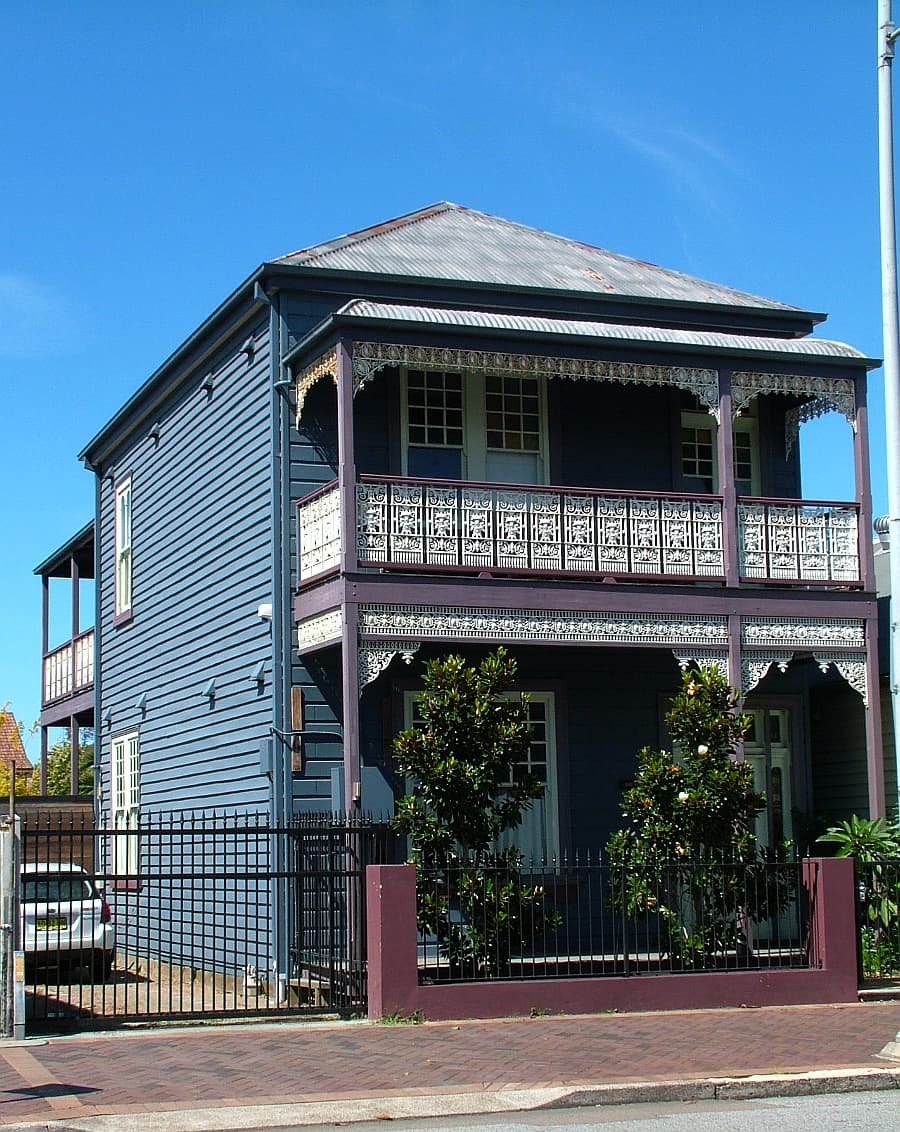
Photo: Mark McIntosh. Victorian townhouse, Hamilton. CC BY-SA 3.0. Source on Wikimedia Commons. Licence. Full credits on the image credits page.

A building report is not an insurance policy with a house attached. It is an opinion, written under a standard, limited by access, and surrounded by sentences that exist because someone once sued. Buyers in Newcastle still arrive at a Hamilton terrace believing the PDF will pay for the next roof. Vendors still arrive believing the same PDF is a personal attack. Neither reading is in the document.
This essay is about what a report cannot do, why it says so, and what you can reasonably expect anyway. It is not legal advice. It is not a claim form. If you want the inspection itself, start with what a pre-purchase building inspection covers. If you want the fence, read limitations and the fine print. The reports and standards hub is where these pages sit together.
Professional indemnity, in general terms
A practising inspector in this state typically carries professional indemnity insurance. In plain language, that is cover for the cost of being wrong in a professional opinion — if they were negligent, and if the opinion was inside the job they agreed to do.
A few distinctions keep people out of a fantasy.
The policy is the inspector’s, not yours. You are not the insured. You may be a person who has suffered a loss because of their work. Those are different positions. The insurer’s first question will not be “is the house leaking?”. It will be “what was the inspector paid to look at, and did they do that job with reasonable care?”
Scope is the whole game. A visual AS 4349.1 inspection of reasonably accessible areas is a narrow job. A defect in a locked room, under a slab, behind a tile membrane, or in a roof that could not be walked is often outside that job. Insurance does not drag it back inside. The limitations essay is the map of that edge.
Negligence is not “something was missed”. It is closer to: a competent inspector, in those conditions, would have seen this and said so. A stain they photographed and called minor, which later became a major, is an argument. A termite gallery they never had a right to open is a different argument. A buyer who skipped the pest half is not covered by the building inspector’s policy for termites.
Public liability is a different policy. That is about bodily injury and property damage — the ladder through the window, the fall. It is not about whether the report was right.
Ask, when you choose an inspector, whether they hold current professional indemnity cover for pre-purchase work. You do not need to become their broker. You do need a yes that sounds like a yes. A cheap report with no meaningful cover leaves you arguing with a person, not a policy.
None of this is a promise that a particular insurer will pay a particular claim. Policies have excesses, exclusions, notification rules, and limits. Practice varies. A solicitor reads policies. A journal does not.
Why reports disclaim
The disclaimer is not an optional personality. It is how the industry survived its own customers.
A pre-purchase report is written in a few hours about a building that may be a hundred years old, on a morning the vendor still lives there, for a reader who is about to make the largest decision of their decade. The reader would like certainty. The building will not provide it. The standard will not pretend.
So the report says, in one register or another:
- this is a visual inspection of accessible areas at a point in time
- it is not a warranty, a guarantee, or a certificate of compliance
- it is not a pest report unless a pest report was commissioned
- it is not a survey, an engineering assessment, or a quote
- furniture, locked rooms, unsafe roofs, and inaccessible voids were not inspected
- weather, occupancy, and safety limited the walk
- the inspector is not responsible for hidden or concealed defects they could not reasonably have seen
Those sentences feel hostile when you have just paid several hundred dollars. They are hostile to a fantasy, not to you. The same report, if it is any good, will also contain specific photographs, named defects, and a recommendation you can act on. The disclaimer and the finding are allowed to coexist. Buyers who read only the disclaimer decide the report is useless. Buyers who read only the findings decide it is a court order. Both have stopped reading.
There is a commercial reason too. Insurers and lawyers draft for the worst morning, not the best. A Victorian townhouse on Beaumont Street can hide a century of kindness and a decade of cheap work. The inspector who does not disclaim the unseen is offering a product they cannot sell twice.
That does not make every clause sacred. A disclaimer that tries to say the inspector is not responsible for anything they failed to notice in an open room is a different animal from a clause about inaccessible areas. If the language swallows the job, ask the inspector to say, in a sentence, what they are standing behind. If they cannot, you have learned something before the visit.
What a buyer can reasonably expect
Expectation is where most of the disappointment lives. A fair list looks like this.
You can expect a systematic look at what could reasonably be reached, in the time booked, under the standard named in the agreement. You can expect the inspector to try the hatch, the subfloor, the exterior, the wet areas, and the obvious structure. You can expect them to say when they could not.
You can expect defects to be described in language that has a consequence. Minor, major, safety, further investigation — the words vary. The consequence should not. How to read an AS 4349.1 report is the companion. A pile of “monitor” is not a report. A clear major on a roof that is at the end of its life is.
You can expect photographs that argue, not a slideshow. A crack with a context. A stain with a location. A meter reading, if they took one, attached to a sentence. Thermal cameras and moisture meters do not change this. They add a kind of evidence. They do not add a warranty.
You can expect to be able to call them. A report that cannot be queried is a pamphlet. A good inspector would rather explain a pier than meet you first in a complaint.
You cannot expect the report to pay for the house. It will not underwrite the next winter. It will not certify that the ensuite membrane was installed correctly. It will not settle a boundary. It will not replace a council records search. It will not, by itself, win a renegotiation — though it is the usual tool; see using a report in the Hunter market.
You cannot expect omniscience in an occupied building. A tenanted terrace, a packed garage, a locked loft, a roof in weather — these produce honest holes. The pre-purchase problem is often access, not indemnity.
You cannot expect the inspector to tell you whether to buy. That decision includes money, taste, time, and the kind of owner you are prepared to be. The report is an input. The after the inspection hub is about the rest.
Strata adds a further limit: the inspector of your lot is not the inspector of the scheme. Common property has its own documents and, often, its own report. Strata and townhouse inspections is the longer version. Do not ask a lot report to insure you against the building next door.
When a claim is even a conversation
People reach for the inspector’s insurance when a defect appears after settlement. Sometimes that is the right direction. Often it is a way of not looking at the agreement they signed.
A conversation that has a chance of being real usually has most of these:
- the defect was in an area the inspector could reasonably access
- it was the kind of defect the standard asks them to report
- it was present and visible, or should have been found by the method they used, on the day
- the report is silent, or casually wrong, about it
- you still have the agreement, the report, and the photographs
- you raised it with the inspector before you raised it with the internet
A conversation that is usually not a PI claim:
- a leak that began in a storm two months later
- a termite problem after a building-only report
- a compliance issue that needed a council file, not a torch
- a room that was locked, and said to be locked
- a price argument dressed up as a missed crack
Mine subsidence, movement, and old coalfield houses produce cracks that look like negligence and are geology plus time. That is not a reason to forgive a sloppy report. It is a reason to read mine subsidence in the Hunter before you decide what the inspector “must have seen”.
If you are actually in a dispute, stop taking advice from essays. Speak to a solicitor who will read your documents. This journal will not draft your letter of demand, and it will not tell you that a disclaimer is always a wall or never a wall.
How to read a disclaimer without becoming cynical
Read it as a list of things you might still need to buy: a pest report, an engineer, a plumber’s camera, a survey, a planning certificate, a vacant inspection if this one was a squeeze. The disclaimer is a shopping list written in a defensive mood.
Then go back to the body. If the body is specific, the disclaimer has not eaten the job. If the body is a shrug and the disclaimer is a novel, you bought the wrong afternoon.
Do not ask the inspector to delete the disclaimer as a condition of the booking. They will not, and their insurer would not let them. Do ask them to name the standard, the access they need, and the time they will spend. Those are the clauses that still have blood in them.
We do not sell inspections. We do not rank firms. We do not issue insurance. A terrace on Beaumont Street will leak or not leak regardless of how carefully this page was worded. The report is how you find out what could be seen. The disclaimer is how everyone admits what could not. Hold both, and you are harder to hurry.
Questions readers ask
- If the inspector has insurance, am I covered if something is missed?
- Not automatically. Professional indemnity responds if the inspector was negligent within the scope of the job. It is not a policy on the house, and it does not cover defects they were never required to see.
- Why is the disclaimer so long?
- Because the job is visual, limited by access, and has been argued about before. The length is not proof that the report is worthless. It is proof that someone once claimed it was a guarantee.
- Is this legal advice?
- No. This is a journal essay about how reports are written and insured in general terms. A dispute about a particular report is a matter for your own solicitor and the documents you signed.
Keep reading
Building codes, council records and the inspection
Why a walk-through cannot replace a records search — complying development versus a DA in plain language, unapproved work, and where Newcastle, Lake Macquarie and Maitland keep the paper.
Mark Ellison · 17 September 2024 · 12 min read · Photo: Sardaka, CC BY-SA 4.0
Thermal imaging and moisture meters — when they matter
What a moisture meter and a thermal camera actually measure on a Hunter house, where they lie, and when they should change a recommendation rather than decorate a report.
Mark Ellison · 16 May 2024 · 10 min read · Photo: Sam Wilson, CC BY-SA 2.0
Limitations, exclusions and the fine print
What AS 4349 actually leaves out — inaccessible areas, furniture, locked rooms, roofs, and the “visual only” agreement buyers sign and then forget.
Mark Ellison · 19 March 2024 · 10 min read · Photo: Kabang Bladina Gideon, CC BY-SA 4.0