How to read an AS 4349.1 building report
A method for reading the PDF before you ring anyone — limitations first, then majors and safety, then the language of defects, photographs and further investigation.
By Mark Ellison, Standards editor · 3 April 2024 · Updated 14 January 2026 · 11 min read

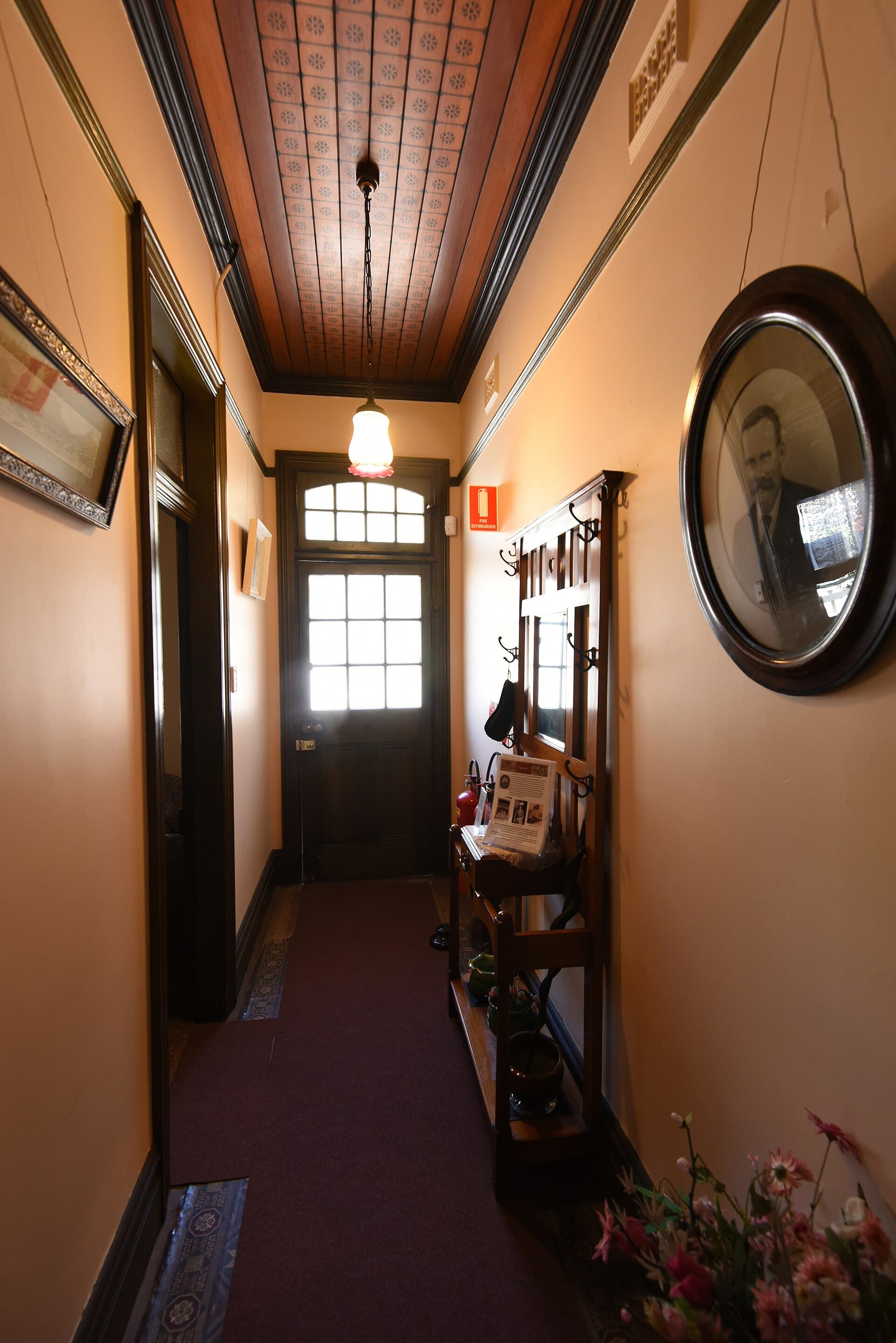
Photo: Mark McIntosh. Jesmond House. CC BY-SA 3.0. Source on Wikimedia Commons. Licence. Full credits on the image credits page.

The PDF arrives after the inspector has left the street. Most buyers open it on a phone, search for the word “major”, and then either panic or decide the inspector is a pessimist. Neither is reading.
An AS 4349.1 report is a document with a sequence. Skip the sequence and you will mis-hear it, and you will take that mis-hearing into a negotiation or an auction hall in Hamilton. This essay is the sequence. For what the inspection is for, start with what a pre-purchase building inspection covers in NSW. For the legal edges of what was not seen, keep the limitations essay open in another tab.
Limitations first, always
The first useful pages are the ones people skip: access, weather, areas not inspected, exclusions. They are not a lawyer’s throat-clearing. They are the edge of the opinion you have paid for.
Look for sentences that tell you, in ordinary language:
- whether the roof void was entered, seen from a hatch, or not found
- whether the subfloor was crawlable, blocked, too tight, or too wet
- which rooms, cupboards or exterior faces were locked, stacked or refused
- the weather on the day — a dry Tuesday in May is not a test of every flashing
- any agreement to exclude a structure: the studio, the old shed, the deck the vendor said was “not part of the sale”
If a limitation is large, the rest of the report is an opinion about a smaller house than the one you think you are buying. A terrace in The Hill with a packed attic and a locked cellar is not the same job as an empty cottage in Waratah. The inspector should have said so. If they have not, that is your first question, not a note you leave for later.
A standard inspection is visual and of reasonably accessible areas. It is not an X-ray of membranes, a camera of every drain, or a survey of boundaries. Those jobs exist. They are not this job. The reports and standards hub is the longer argument.
Then majors, then safety, then the rest
Read the classified defects in that order. Not because minors are fake — they are not — but because your evening has a finite amount of attention, and the market in this city will not wait while you process every scuffed skirting.
Major defects are the items that affect the structural integrity of a building element, make it unsafe, or will be expensive because they are widespread. A roof at the end of its life is a major even if it is not dripping during the inspection. A single cracked brick in a garden wall is usually not, unless the crack is telling a structural story that continues through lintels and jammed sashes.
Safety hazards should be impossible to miss. Unsafe balustrades, a deck pulling from a wall, electrical work that looks unlicensed, a gas appliance that belongs in a museum. If a safety item is buried in a general comments section, treat that as a quality problem with the report, not as a small defect.
Minor defects are maintenance: paint, a slipped tile, a sticky sash, a downpipe that has come adrift. Read them as a pattern, not as a shopping list. A house in Islington or Carrington with forty minors and no majors is still telling you it has not been looked after. That is a cost in weekends and in the next five winters, even if no single line is a walk-away.
Then read the rest — observations, notes, the “for your information” paragraphs — only after you know the shape of the serious items. People who start at the photographs and work backwards tend to remember the dramatic close-up and forget the dry sentence that says the bathroom was not tested because the water was off.
Defect language is not decoration
Inspectors do not share one vocabulary. Some use the standard’s major / minor / safety scale and stop there. Some add further investigation. Some write “significant”, “typical for age”, “monitor”, “consider replacement”. The words matter less than the consequence, but the words are still a contract of meaning between you and the person who stood in the roof void.
Treat the following as a working dictionary, not as a legal glossary:
- Typical for age is not a free pass. An 1890s Italianate house on The Hill is allowed to have old joinery. It is not allowed to have a roof that has finished being a roof. Ask what would still be typical if the same house had been maintained.
- Monitor is only useful if you know what you would be looking for, and when you would stop monitoring and start paying someone. Otherwise it is a polite way of leaving the file.
- Consider replacement is usually a major wearing a milder coat. A roof, a balcony membrane, a set of windows that no longer close — these are not philosophical suggestions.
- Appears and indicative of are the inspector staying inside what they could see. Do not translate them into “fine”. Translate them into “this is as far as a visual inspection can go”.
If two reports on similar stock use wildly different temperatures of language, you are not comparing houses. You are comparing writers. That is one reason to choose a licensed inspector for the quality of their sentences as well as their licence.
Photographs prove a moment, not a life
A good report uses photographs as evidence, not as decoration. Each serious item should have a picture that a stranger could understand next week: the crack in context, not only a crop; the stain with enough wall around it to see the storey; the subfloor with a sense of clearance and debris.
What a photograph cannot do:
- tell you whether the stain is last week’s shower or last decade’s rising damp
- show you the membrane behind the tiles
- prove that a crack is moving, only that it exists today
- stand in for the sentence that says the inspector could not get into the void
If the dramatic pictures are all of peeling paint and the quiet sentences are about the rear wall, believe the sentences. Buyers in Newcastle still lose arguments with themselves because a close-up of mould in a laundry looks worse than a dry note about piers.
Ask for extra photographs if a major item has one unhelpful frame. A serious inspector would rather send another picture of a lintel than have you invent a story about it.
“Further investigation” is a map if it is specific
This phrase does more work than any other in contemporary reports, and it is the one buyers most often misread as a dodge.
It is a map when it names a person and a reason: “licensed plumber to camera the sewer from the boundary”, “structural engineer to review the stepped cracking in the rear wall”, “roof plumber to advise on remaining life of the terracotta”. Those are jobs you can book before exchange, or prices you can take into a renegotiation.
It is a dodge when the same phrase is sprinkled over every second line, or when “monitor” and “further investigation” are used interchangeably. A report that will not decide anything is not cautious. It is incomplete.
In the Hunter this comes up constantly around:
- water — bathrooms in 1980s brick veneer, the junction between an old cottage and a new pavilion, roofs that have been patched rather than renewed
- structure — stepped cracks, bouncing floors, lintels, the particular local habit of thinking about mine subsidence without treating every crack as a disaster
- timber pests — conducive conditions in a building report are not a timber pest inspection. If the building inspector is not also reporting to AS 4349.3, you have not bought a pest opinion. See combined versus separate reports and termite risk in the Hunter
Book the named specialist while you still have time. Timing the inspection around exchange is partly about leaving a day for the plumber’s camera, not only for the first PDF.
What to ask the inspector
You are allowed to ring. A good inspector would rather explain a pier than read about themselves in a complaint. Do it once, with notes, not as a running commentary from the car park of a Westfield.
Useful questions are specific:
- Which three items would you spend money on in the first year if this were your house?
- Which limitations actually change the opinion — which rooms or voids, if opened, might move a minor to a major?
- When you wrote “further investigation” on the rear wall, what would a reassuring engineer’s letter need to say?
- Is the roof a replace-soon or a replace-when-you-can?
- Did anything look like unapproved work that council records would clarify better than another walk-through?
Useless questions are the ones that ask the inspector to become your solicitor, your valuer, or your fortune teller. They cannot tell you what the vendor “should” pay. They cannot tell you that the house will not leak next winter. They can tell you what they saw, what they could not see, and how they ranked it.
If you attended the inspection, use the call to check your memory against the page. If you did not attend, say so. Absence is not a crime. It does mean you have less of a shared picture, and you should not pretend otherwise.
How the reading feeds a negotiation
The report is not a moral judgement on the vendor, and it is not a voucher for a new house at an old price. It is a list of facts you can choose to price.
Using a report to renegotiate in the Hunter market is a craft with its own essay. The reading comes first, and it looks like this:
- Separate safety and structure from paint.
- Put a number, even a rough one, on the items you would have to deal with before you slept well — roof, wet area, movement, pests — by talking to trades, not by guessing from a Facebook group.
- Decide which of those numbers belong in a request to the vendor, and which belong in your own maintenance calendar.
- Decide whether the remainder is a house you still want. Walking away is sometimes the cleanest use of a clear report.
At auction there is no cooling-off in which to do this slowly. The reading has to happen before you raise a hand. In a private treaty you have a short, expensive week. Do not spend it arguing with the photographs.
On strata and townhouses the same method applies, with a smaller lot and a larger argument about common property; that is a separate essay. New houses can look finished and still be wet; new builds versus established homes is the companion psychology.
A working order for the evening
When the file lands, do this in order and stop if you need sleep:
- limitations and access
- major defects
- safety
- further investigation items that name a trade
- the pattern of minors
- photographs that attach to the serious sentences
- one list of questions for the inspector
- one list of items that might be a negotiation
- one sentence to yourself about whether you still want the house
Then put the phone down. The pre-purchase problem is not a shortage of information. It is a shortage of sequence. The house will still be the house in the morning. The report is how you stop inventing it.
Questions readers ask
- Should I start with the summary page?
- Only after you have read the limitations. A summary that looks calm can hide a roof void that was never entered. The limitations tell you what the calmness is sitting on.
- What does “further investigation” actually mean?
- It is a referral, not a shrug, when it names a trade and a reason. It is a shrug when every second item says “monitor”. Ask the inspector which of the two they meant.
- Can I send the report to the vendor’s agent as-is?
- You can. Better to decide first which items are the negotiation and which are ordinary maintenance. A raw PDF dumped at midnight is not a strategy.
Keep reading
Strata and townhouse inspections in Newcastle
Lot versus common property, the access you will not get, and why a harbour apartment and a Merewether townhouse need the same walk-through and a different set of records.
Priya Nair · 14 August 2024 · 11 min read · Photo: Sardaka, CC BY-SA 4.0
New builds versus established homes — the inspection
Why a finished-looking new house still needs a walk-through, how warranties are not reports, and what old paint and new paint each hide in the Hunter.
Helen Cartwright · 9 July 2024 · 10 min read · Photo: Orderinchaos, CC BY-SA 3.0
Auction versus private treaty inspection strategy
Inspect before you bid, set a walk-away price, and treat a vendor report as someone else’s document — with the different tactics that work in Hamilton, Cooks Hill and Charlestown.
Sophie Brennan · 18 June 2024 · 11 min read · Photo: Mark McIntosh, CC BY-SA 4.0