Using a report to renegotiate in a Hunter market
How majors and minors behave in a hot or cooling Hunter market — talking to the agent, getting quotes, and knowing when a report is a lever and when it is only a list.
By Sophie Brennan, Consumer editor · 24 April 2024 · Updated 28 February 2026 · 11 min read
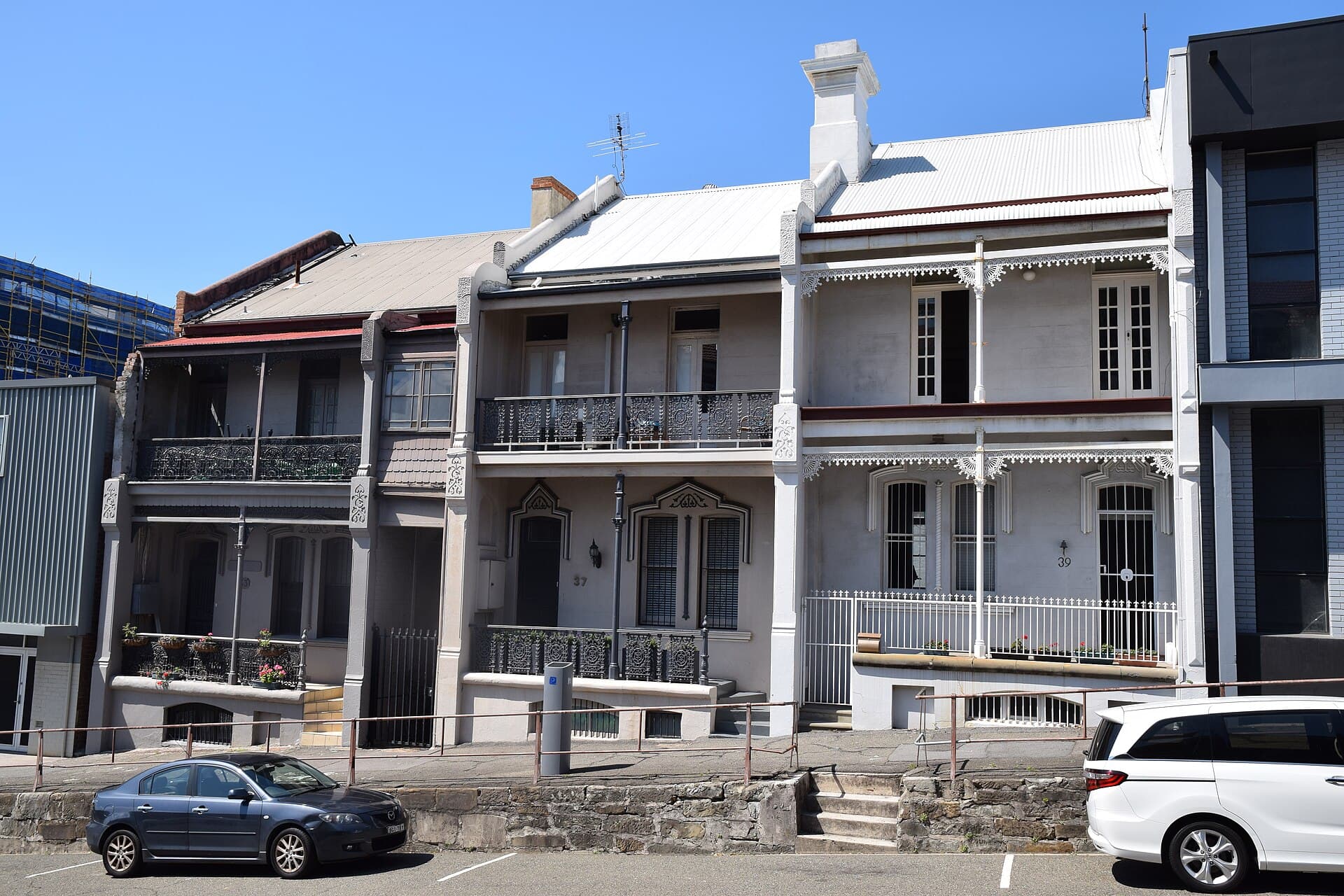
Photo: Hugh Llewelyn. Victorian terraces, Civic. CC BY-SA 2.0. Source on Wikimedia Commons. Licence. Full credits on the image credits page.

The PDF arrives on a Thursday afternoon and the house, which looked generous at the open home, becomes a list. Most buyers then do one of two unhelpful things. They treat every scuffed skirting as a moral failing by the vendor, or they decide the report is “just an old house” and stop reading at page four. Neither is a negotiation.
A pre-purchase report written to AS 4349.1 is an opinion on accessible areas at a point in time. It is not a quote, a warranty, or a verdict that you have been cheated. Used properly, it is a document that lets you decide what the house is worth to you in this market, and whether anyone on the other side of the table has a reason to move. That work sits in the after the inspection hub. The inspection itself still belongs to pre-purchase.
If you cannot yet read the vocabulary — major, minor, safety, further investigation — stop here and open how to read an AS 4349.1 report. Renegotiation that begins with the wrong words wastes the five days you actually have.
What moves money, and what does not
A major defect is the inspector’s way of saying a building element is structurally compromised, unsafe, or so widespread that it will be expensive. A roof at the end of its life is a major even if it is not dripping during the visit. Active water in a wall, a deck pulling away from the house, a subfloor that has given up — those are majors. They are the items you price.
A minor defect is usually maintenance. Paint, a slipped tile, a sash that sticks after a wet week in Hamilton. It should still be in the report if it is real. A long list of minors can be a story about neglect. It is not, by itself, a schedule of deductions you read aloud to an agent on Beaumont Street.
Safety items sit above both. An unguarded drop, suspect electrical work, a gas appliance that looks older than the brickwork — you do not “negotiate” those in the sense of splitting the difference. You decide whether the house can be made safe before you sleep in it, and what that costs.
Further investigation is a map, not a price. “Licensed plumber to camera the sewer” is useful. “Monitor” on every second line is not. If the serious items are all further investigation, you may not yet have a report you can bargain with. You have homework, and timing around exchange will decide whether you can finish it.
The limitations matter here more than people admit, and so do the disclaimers: a report is not a policy and not a quote. You cannot ask a vendor to pay for rooms the inspector never entered. If the roof void was stacked with insulation and the subfloor was a crawl you could not make, the report is thinner than the asking price. That is sometimes a reason to walk away. It is a poor reason to invent a number.
Hot market, cooling market
The same cracked lintel is a different sentence in a different week.
In a hot inner-Newcastle market — Cooks Hill, The Hill, Hamilton, the better streets of Waratah when three parties are still circling — a report is mostly a decision tool for you. The vendor does not have to care. The agent will say, truthfully, that another buyer is less interested in the fascia. Your move is to decide your walk-away number, including the majors, and either meet the market or leave. Trying to shave the price for peeling paint in that climate is how you lose the house and look like a tourist.
In a cooling market the same report becomes a conversation. A house that has sat on a board in Charlestown, a lake fibro that has had two price drops, a coalfield brick with a quiet open home — the agent is returning calls. Majors that are priced with quotes get a hearing. You still do not nickel-and-dime the interior. You put the roof, the wet area, the termite work on the table and you ask for a figure or a credit that a reasonable vendor can defend to themselves.
The Hunter is not one market. A terrace in Civic and a 1970s veneer in the same week can be living in different decades of demand. Speak to the street you are actually buying, not to a headline about “Newcastle”. Hunter housing stock is the longer map of why those streets fail differently — weatherboard cottages and 1970s–90s brick veneer do not present the same majors.
Mine subsidence and coastal corrosion complicate the money further. A stepped crack on a coalfield house may be a maintenance item or a reason to ring an engineer; that distinction is in the mine subsidence essay. Salt and steel from Stockton to Redhead have their own bill, set out in coastal corrosion. Do not use either as a theatrical deduction. Use them as a reason to get the right second opinion before you name a number.
Talking to the agent
The agent is not your friend and is not your enemy. They are employed by the vendor. They can carry a clear request. They cannot usefully carry a mood.
Do this:
- Write a short letter or email. Three paragraphs is plenty. What you want (a reduction, a credit at settlement, vendor works — pick one), which items justify it, and what evidence you have attached.
- Attach the relevant report pages and any quotes. Not the whole file unless they ask.
- Give a time by which you need an answer that fits the cooling-off, if you are in one.
- Stay polite. Rudeness does not make a lintel cheaper. It does make the agent stop returning the call.
Do not do this:
- Ring from the car on the Pacific Highway and “just run through a few things”.
- Ask the inspector to ring the agent “and explain”. The inspector’s job was the house. Yours is the money.
- Threaten to “take it further” over items the report itself calls minor.
- Demand the vendor “make good” a list of cosmetics you would repaint anyway.
If the house is tenanted and access was poor, say so. A hollow report is a fact about risk, not a smear. The pre-purchase pieces on access and timing are worth citing in that letter if the agent pretends the inspection was complete.
Quotes versus the report
Buyers keep treating the report as if it contained prices. It does not. An inspector licensed to walk a house is not a quantity surveyor, and a sentence that says a roof is at the end of its life is not a supply-and-install figure from a roofer in Mayfield.
When time allows — and in a private treaty it often does, if you did not waste the first three days — get one or two written quotes on the majors you intend to argue. A quote does three things a report cannot:
- it turns a defect class into a number a vendor can recognise
- it shows you are not inventing a scare
- it tells you whether you can live with the work if the vendor refuses
Quotes have limits. A roofer who has not been on the roof is estimating. A plumber who has not opened the wet area is guessing at the membrane. Say so in your letter. “Indicative quote pending access” is honest. A made-up round number is not.
Do not collect quotes for paint, a sticky door, or a cracked pane you would live with. That is how a serious conversation about a bathroom leak becomes a haggle over hardware. The vendor’s instinct, and the agent’s, will be to treat you as someone who wants a new house at an old price.
Pest work is a separate invoice and a separate standard. If you only bought a building report, you do not have a pest figure to negotiate. If you bought both, and there is activity or damage you cannot price from the doorway, that is often a reason to stop rather than a reason to guess. Termite risk in the Hunter is not a Sydney story that fades at the Hawkesbury.
A moisture blotch or a thermal image is not a quote either. Read thermal imaging and moisture meters before you wave a colour printout at an agent as if it were a plumber’s invoice.
Auction versus private treaty
These are different games. The auction versus private treaty essay is the strategy piece. The short version for renegotiation is this.
Auction
You inspect early enough to walk away. You read the report. You get the quotes you can get. You decide the last number you will bid, with the majors inside it. On the day you bid or you do not. You do not win the auction and then produce the PDF as a surprise. In New South Wales there is, in the ordinary residential auction, no cooling-off in which to perform that trick.
People still try. It wastes everyone’s Saturday and it does not work. If the report is bad enough that you cannot name a number, you are not at an auction. You are at a viewing you should have left.
Private treaty
You have a contract and, on a typical residential purchase, a short cooling-off. That is the window. Use it to read, to quote, and to write the letter. The vendor may reduce, may offer a credit, may agree to do specified work, or may say no. All four are legitimate. Your leverage is the quality of the majors and the state of the market, not the fact that you commissioned an inspection.
Vendor works are the option that looks kind and often goes badly. You do not control the trade, the product, or the finish, and you inherit the result. A reduction or a credit at settlement leaves the work in your hands. If you take vendor works anyway, specify the scope in writing as if you will have to live with a stranger’s idea of “fixed”.
Strata and townhouses add a third party — the owners corporation — that will not renegotiate your bathroom for you. That problem has its own essay. New builds have a different psychology again: they can look finished and still be wet, and the warranty conversation is not the same as a price conversation on a 1928 weatherboard. See new builds versus established homes.
Do not nickel-and-dime the paint
This is the sentence buyers skip and then regret.
A fair report on an old Hunter house will mention paint. It will mention a cracked pane, a garden bed against a vent, a laundry tub that has seen better decades. Those things are true. They are also the cost of buying a house that has already been used. If you use them as ammunition, two things happen. The vendor decides you are not a serious person, and you train yourself to think that ownership is a process of extracting a showroom from a stranger.
There is a difference between a house that has not been maintained and a house that has been lived in. The first is a pile of minors that points to a major you have not priced yet — a roof never cleared, a wet area never looked at, timber never treated. The second is a Saturday. Learn how the report classifies before you confuse the two.
If the only things you can find to argue are cosmetics, you do not have a renegotiation. You have a decision: pay the price and live with a fair report, or leave. Both are adult. Splitting the difference on a feature wall is not.
What a fair ask looks like
A fair ask in this city is specific, priced, and limited to work that will still matter in twelve months.
- The roof needs replacing or a defined repair. Here is the quote. We ask for this reduction.
- The rear deck is unsafe. We will not occupy it. Here is the quote to rebuild. We ask for this credit at settlement.
- There is an active leak in the wet area. Further invasive work is likely. We ask to proceed only if the price moves by this amount, or we walk.
A fair ask is not:
- ten per cent because “old houses”
- a shopping list of touch-ups
- a demand that the vendor’s cousin “have a look”
- silence until the last afternoon of cooling-off, then a dump of the PDF
If you intend to keep the house and repair it, read sequencing an older house before you spend the negotiation on the wrong trade. Water first. Structure. Pests. Paint last. A vendor credit spent on a kitchen while the gutter still feeds the subfloor is how people buy a report and ignore it.
Council records and the paper trail sometimes change the ask — an unapproved pavilion is not a scuffed skirting. Raise those with the conveyancer, not as a decoration on the building list.
After they say no
They will sometimes say no. In a hot street that is the usual answer. You then buy at your number or you do not. The report has still done its job: you know what you are taking on. Living with a fair report is the essay for that outcome. Walking away is the other.
Vendors who already hold a pre-sale inspection are harder to surprise and easier to talk to, if they have used it honestly. That is their essay. A buyer who commissions nothing and hopes to renegotiate from a feeling is not in this conversation at all. Choosing a licensed inspector is still the first practical step, and the reports and standards hub is the rulebook.
A note on this journal
We do not sell inspections and we do not sit in the room with your agent. The point of this page is to stop you using a serious document as a tantrum, or ignoring it as a vibe. The house will still be the house after the email. The market will do what it is doing this month. Your job is to decide, with the majors in front of you, what the keys are actually worth.
Questions readers ask
- Can I renegotiate after an auction in NSW?
- Once the hammer falls you have bought the house on the terms of the contract. A building report is something you use to decide whether to bid, and at what number. It is not a post-auction bargaining chip.
- Should I send the whole report to the agent?
- Send the pages that matter — majors, safety items, and any quote that prices them — with a short written ask. A forty-page PDF without a sentence of your own is easy to ignore.
- Is a pile of minor defects a reason to drop the price?
- A pile of minors can describe a house that has not been maintained. It is rarely a reason to argue over paint. Price the work that will still be there after you have lived in the place for a year.
Keep reading

Living with a fair report — maintenance calendars
A fair report is a maintenance brief. Gutters, vents, wet areas, paint and pest inspections after settlement, set to the Hunter year.
Helen Cartwright · 15 October 2024 · 11 min read · Photo: Procsilas Moscas, CC BY 2.0

Pre-sale inspections for Hunter vendors
Why Hunter vendors commission an inspection before listing, what is worth fixing, and how a pre-sale report changes the conversation without hiding the house.
Helen Cartwright · 26 September 2024 · 10 min read · Photo: David Baron, CC BY-SA 2.0

When to walk away from a Newcastle purchase
The cases where a Newcastle purchase should end after the report — safety, structural doubt, unpriceable pest work, a hollow inspection, and the heat of an auction.
Sophie Brennan · 21 August 2024 · 10 min read · Photo: Kabang Bladina Gideon, CC BY-SA 4.0