Subfloor ventilation and moisture in coastal Newcastle
From Stockton to Redhead the crawl space stays wet — blocked vents, plastic on soil, bathrooms leaking into the dark, and why lake suburbs and rising-damp language keep getting in the way of a clear diagnosis.
By Tom Reilly, Timber pest correspondent · 5 September 2024 · Updated 8 March 2026 · 10 min read
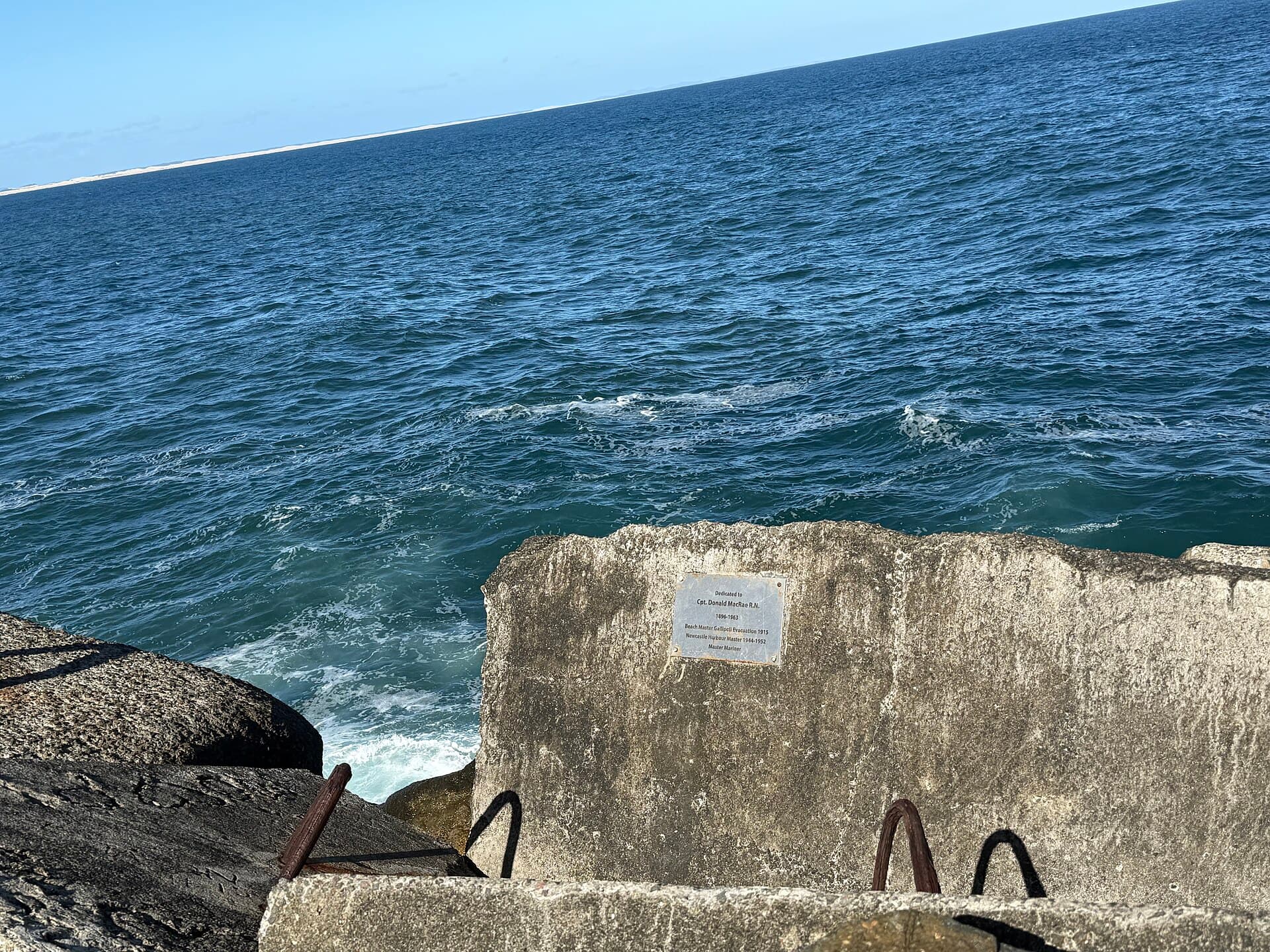
Photo: DaHuzyBru. Nobbys Breakwater, Newcastle. CC BY-SA 4.0. Source on Wikimedia Commons. Licence. Full credits on the image credits page.

Stand on Nobbys at the end of a wet week and the air coming off the water is not a metaphor. It is moisture with salt in it, hitting a strip of housing that has been taking that weather since the nineteenth century. From Stockton through Newcastle East, The Hill, Bar Beach, Merewether, Dudley and out to Redhead, the same air that rusts a window bar will keep a subfloor from drying. Termites did not design the coastline. They use it.
This essay is about the crawl space — ventilation, wet soil, leaking wet areas — and the language that muddles it. It belongs with the insects in the pest and termite hub as much as with the building. For the animals themselves, read termite risk in the Hunter. For the hunt, read what a timber pest inspection looks at. Moisture is a building fact as well as a pest fact; the pre-purchase building inspection will often see it first. The coastal steel story is corrosion from Stockton to Redhead. This page is the damp.
What a subfloor is doing when it works
A suspended timber floor is supposed to sit above a volume of air that changes. Vents in the piers or the walls let the space breathe. Soil moisture evaporates, the air carries it out, the bearers stay closer to dry than to wet. Ant caps, if they were installed and if nobody has bridged them with soil or render, are a modest obstacle at the stump. None of this is exotic. It is the original logic of most weatherboard cottages in the inner suburbs and of a great many older houses around the lake.
When it fails, the failure is ordinary:
- the air does not move
- the soil stays wet
- timber sits in a climate it was not meant to occupy all year
- fungal decay starts in bearers, joists, bottom plates
- subterranean termites find the timber more worth the walk
A timber pest inspector is paid to notice that climate even when they do not find live insects. Conducive conditions are not a decorative heading. They are the reason the next inspection might not be so quiet.
Salt air, and why it does not save you
Buyers still say, of a Merewether or Stockton house, that it cannot be a termite place because of the salt. Salt is hard on steel and on some metals in the envelope. It is not a termite treatment. Coptotermes will forage under a coastal cottage as readily as under a house in Waratah. The sea breeze can even work against you if it drives rain into walls and keeps the southern side of a building damp.
What the coast does reliably is this: it keeps relative humidity high, it throws rain in on nor-easters, it makes owners close things up against the weather, and it encourages a culture of outdoor living that piles decks, storage and gardens against the very walls that needed to breathe. Carrington and Maryville add low ground. Newcastle East adds tight sites. The Junction and Hamilton South add a century of plumbing. Redhead and Dudley add the same salt with a bit more bush at the back fence.
If the subfloor vents are the original terracotta or brick openings, they were sized for a house without later bathrooms, without later paving to the weepholes, and without an air-conditioning condenser sitting in front of two of them. The original designer is not coming back to redraw the airflow.
Blocked vents, raised gardens, later paving
The most common Hunter subfloor story is not a mysterious rising tide. It is a vent you cannot see.
Painted shut. Rendered over in a “tidy up”. Buried by a garden bed that has crept up the wall for twenty years. Hidden behind a hot-water heater, a stack of timber, a dog kennel, a heat pump. Paving laid tight to the wall so that rain has nowhere to go except against the brick and down toward the soil under the floor. Weepholes in a brick veneer given the same treatment, which is a wall-cavity problem as well as a pest one.
On inspection day this looks like a small item. In the report it should not. A blocked vent is a statement about the climate of every bearer in that bay. Several blocked vents is a statement about the house. The inspector should say which elevations are affected, whether any airflow remains, and whether the soil grade is now above the damp-proof course or the ant cap.
Unblocking vents is maintenance. It is also sometimes a negotiation with a garden you like. If you buy, you own that argument. The living with a fair report essay is for people who will actually cut the garden back.
Plastic on soil, which is not automatically a vapour barrier
A designed layer versus a tarp from the boot
Owners put plastic under houses for reasons that sound tidy. Stop the dust. Stop the smell. Stop the moisture. Sometimes a ground vapour barrier — continuous, weighted, detailed to walls, with enough fall that water does not pond — will reduce evaporation from the soil into the subfloor air. That can be useful on a wet site. It is a building detail, not a tarp from the boot of the car.
What inspectors find instead:
- torn plastic holding puddles against a stump
- builder’s film left over a previous leak, now a sauna
- plastic lapped up onto timber
- plastic covering the vents from the inside
- a patchwork of bags and sheeting that tells you someone was worried and then stopped
If the soil is wet because a downpipe dumps there, plastic will not forgive the downpipe. If the soil is wet because the bathroom waste is leaking, plastic will hide the stain until the bearer fails. Fix the water. Then talk about a barrier as a designed layer, with the vents still doing their job.
Stored belongings on the soil — cardboard, firewood, old pine offcuts — are a second, simpler mistake. They are cellulose on damp ground under a house. Move them. The timber pest inspection will record them as conducive if they are still there on the day.
Bathrooms leaking into the dark
Coastal or not, the wet area above the crawl space is how a lot of Hunter subfloors actually get wet.
A shower without a competent membrane, a bath with a failed seal, a laundry that has leaked for years into the corner of a room nobody looks under. The building inspector sees the sprung flooring, the smell, the moisture-meter numbers at the hob. The pest inspector sees a climate: wet soil or wet masonry under a wet room, timber at a moisture content that interests both decay fungi and termites, sometimes mudding on the nearest pier because that is where the moisture trail led.
These are not separate mysteries. A combined “building and pest” that rushes the subfloor will miss the join; the combined versus separate piece is blunt about that. A building-only job to AS 4349.1 should still report the leak. It will not complete the timber pest hunt unless you paid for AS 4349.3 as well.
If the report says further investigation by a licensed plumber, that is not filler. Camera the waste. Open the hob if you must, with permission. Buying the house with a “we’ll recaulk it” plan is how you inherit a subfloor climate.
Ventilation language versus rising-damp language
Rising damp is a specific mechanism: groundwater moving up through masonry by capillary action, often where a damp-proof course has failed, been bridged, or never existed. It leaves a tide mark, salts, crumbling plaster, a particular pattern on an inner wall. Victorian terraces in Civic and Cooks Hill get this diagnosis, sometimes correctly.
Poor subfloor ventilation is a different mechanism: still air, evaporating soil moisture, condensation, timber and plaster absorbing humidity from below. The smell is musty. The bearers are wet. The floorboards cup. There may be no tide mark on the hallway wall at all.
Falling damp and lateral damp — rain, overflows, a garden against a wall — are different again. Coastal corrosion is different again: metal, salt, wind.
Mixing these words is how people buy a chemical damp-course injection they did not need, while the vents stay blocked and the shower keeps leaking. An inspector who writes “damp” without a mechanism is handing you a mood. Ask which mechanism they mean. Ask what they want done first. Often the first work is grading, drainage, vents, and the bathroom — cheaper than a mystical treatment of the bricks, and more relevant to termites.
The limitations essay applies when the inspector could not get under the house to tell the difference. Unseen is unseen. Do not fill the gap with the most expensive noun.
Lake suburbs, which stay wet without the salt
Leave the coast and the problem does not expire. Belmont, Warners Bay, Speers Point, Toronto, and the older streets around the northern lake sit in still, humid air with a water table that does not always have the manners to stay down. After rain a crawl space can smell like a riverbank. Clay holds water. Timber floors were built close to the ground because that is how they were built.
Coalfield towns further up the Hunter can be drier in a westerly and then just as wet after a week of rain. The principle is the same. If the vents are blocked and the soil is wet, the timber is in a climate that Hunter housing stock was only going to tolerate if someone maintained it.
Lake fibro and coastal weatherboard fail differently above the ground. Under the ground they fail in the same damp. A timber pest inspection that skips the hatch because “it’s only a lake house” is not an inspection.
What to do with the finding
If you are buying, a wet or unventilated subfloor is not automatically a reason to walk away — unless you cannot get under it, the timber is already gone, or live termites are in the structure and the vendor will not face that. It is a reason to price the work: vents, drainage, plumbing, possible timber repair, a proper pest job if one has not been done. The pre-purchase sequence still holds. Be there. Ask to see the hatch open.
If the find is live termites in that climate, you are no longer in a ventilation essay. You are in treating versus monitoring.
If you already own the house, the maintenance is unglamorous and effective: clear the vents, drop the garden, fix the downpipe, fix the shower, keep cellulose off the soil, book a timber pest inspection on a calendar rather than after a scare. That is the whole of the after the inspection temperament, applied to a crawl space.
A note on this journal
We do not install fans, membranes or damp courses. We do not rank “subfloor specialists”. The point of this page is to keep salt, lake water, blocked vents and rising damp in separate sentences, so that the insects — when they come — are not blamed for a climate you could have changed with a shovel.
Questions readers ask
- Is a musty subfloor the same thing as rising damp?
- No. Rising damp is moisture moving up through masonry by capillary action. A musty crawl space is often poor ventilation, wet soil, or a leak. The treatments are different. Mixing the words wastes money.
- Should I put plastic sheeting on the soil under the house?
- Not as a casual dump of tarps. A properly detailed ground vapour barrier can reduce evaporation into the subfloor. Plastic that traps water against timber, blocks vents, or sits in pools will make the crawl space worse.
- Do blocked vents cause termites?
- They cause still, humid air and wetter timber, which are conducive conditions. They are not a finding of termites. They are a reason for a timber pest inspection to look harder, and for an owner to unblock the vents.
Keep reading
Treating versus monitoring after a termite find
Live termites in a Newcastle purchase are a decision, not a weekend DIY job — chemical barriers and baiting in general terms, structural repairs, vendor obligations, and the case for walking away.
Tom Reilly · 27 June 2024 · 11 min read · Photo: Michael Gardner, Public domain
What a timber pest inspection looks at
A practical account of AS 4349.3 in Newcastle and the Hunter — soundings, mudding, frass, roof voids, subfloors and the landscaping that feeds a house, plus the cavities no honest inspector will pretend to have seen.
Tom Reilly · 2 May 2024 · 11 min read · Photo: Sam Wilson, CC BY-SA 2.0
Combined building and pest versus separate reports
AS 4349.1 and AS 4349.3 are different jobs. In Newcastle they are often sold as one afternoon — what you gain in convenience, what you lose in attention, and when a specialist timber pest inspection is worth commissioning on its own.
Tom Reilly · 28 March 2024 · 10 min read · Photo: One Salient Oversight, Public domain